Medical Robot “STAR” Performs First Surgery Without Human Assistance
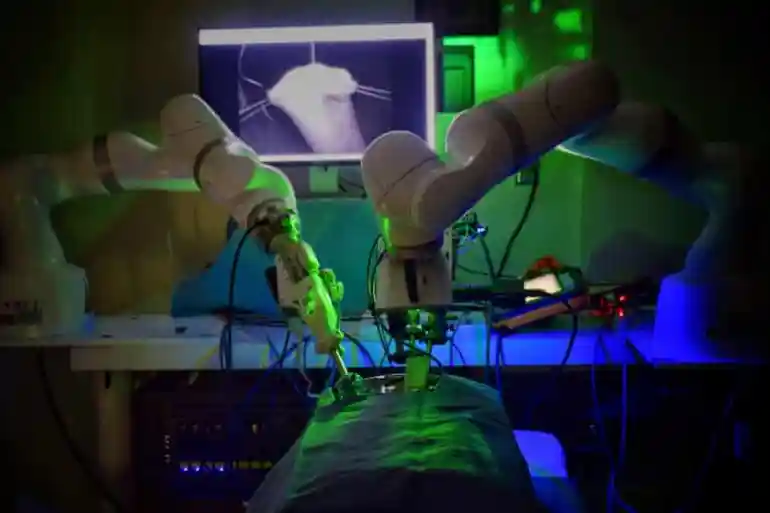
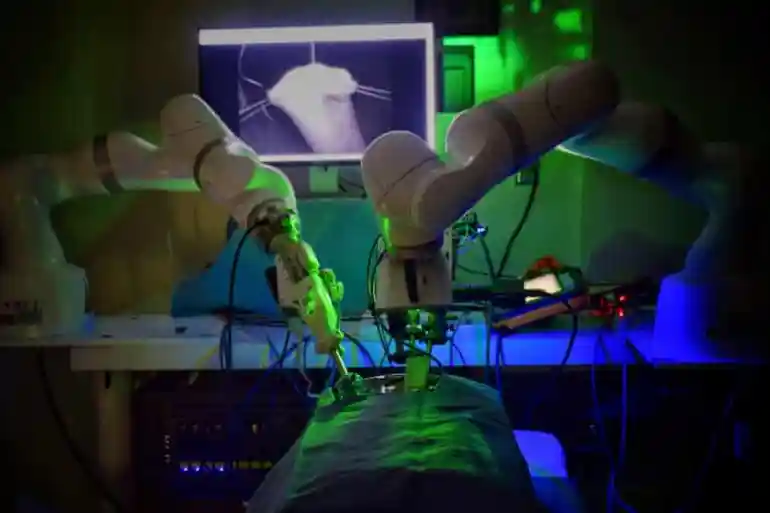
Laparoscopy was the first operation performed by the medical robot “STAR” without human assistance, according to what was announced by “Science Robotics” journal.
The medical robot ”STAR” performed its first surgery without assistance on a group of patients consisting of 4 pigs,
and this procedure is typically performed to treat intestinal cancer in humans, during which a portion of the small intestine is resected.
During this operation, the Smart Tissue Autonomous Robot ”STAR” reconnected the two ends of the intestine in four pigs using laparoscopy,
and according to ”Science Robotics” journal, the STAR robot performed this operation with a very high level of precision and excelled in carrying out its task to the fullest.
A member of Johns Hopkins University, ”Axel Krieger”, stated: “This is the first time a robot has performed laparoscopic surgery without human assistance”.
He also added: “Our findings show that one of the most complex and delicate tasks in surgery — reconnecting the two ends of the intestine — can be automated”.
He then said: “The robot performed the operation on four animals and achieved results far superior to those of humans who performed the same operation”.
Laparoscopy: Comparing Human vs. Machine.
The danger of this procedure lies in the possibility that one of the sutures is placed incorrectly,
which would lead to leakage and serious complications.
The most challenging aspect is that during laparoscopy, the surgeon must insert surgical instruments through small incisions,
approximately 1 to 3 centimeters in length, and despite the narrowness of the incisions, a small space must also be left for visibility.
All of the above accounts for the errors that surgeons make during this procedure,
and justifies failures when they occur, because as we have detailed, laparoscopic surgery truly requires a high level of precision in every detail.
The medical robot ”STAR” succeeded in performing this operation, which is considered the first it has carried out without human assistance.
It also demonstrated its superiority in this regard, and according to those responsible for developing and monitoring this robot,
this superiority is due to the presence of an artificial intelligence system that greatly contributed to regulating its movements in accordance with the breathing process of the pig on which the operation was performed, and also
the camera with which it is equipped helped it get closer to the wound, by providing it with detailed images of the wound’s depth.
And with all the precision to which the Smart Tissue Autonomous Robot was ultimately calibrated,
the result was highly satisfactory, and it managed to repair the wound precisely, which prevented any leakage.
Compared to the sutures performed by human surgeons, the latter are nothing in comparison to the former.
Will We Have Surgical Robots Instead of Humans in the Future??
This is what most researchers expected after the success of the Smart Tissue Autonomous Robot
in performing the first operation without human assistance.
And not only that — what led researchers to expect this is the level of its success, which far surpasses that of humans.
They then confirmed that after this successful step, robots must be introduced into the field of surgery, especially precision surgery.
In addition, ”Axel Krieger” said that the robot ”STAR” will be ready to perform surgical operations on humans within no less than 5 years, and this corroborated researchers’ views on seeing surgical robots in the future without human assistance.
Read also:
- Exynos 2200: A New Processor from Samsung
- Smart Home Devices at CES 22
- Detecting Computer Viruses Without Specialized Software