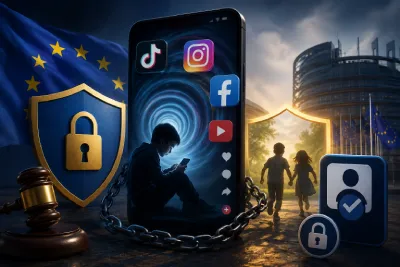
How many times have you opened TikTok for two minutes and found yourself still scrolling an hour later? That feeling, familiar to adults as much as children, is what the European Union wants to tackle. The EU is preparing tough steps against what it calls "addictive design" on social media platforms, part of a growing effort to protect children and teenagers from the harms of excessive app use.
Von der Leyen targets infinite scroll and autoplay
European Commission President Ursula von der Leyen said the EU is working on measures targeting features such as infinite scroll, autoplay and push notifications on apps like TikTok, Instagram and Facebook, seeing them as drivers of digital addiction.
According to press reports on her speech in Copenhagen in May 2026, she said the Commission would target "addictive and harmful design practices" in a new law, the Digital Fairness Act, expected to be proposed toward the end of the year. She also said the EU should consider a minimum age for social media, based on recommendations from an expert panel.
Why are these features called "addictive"?
- Infinite scroll: the feed never ends, so there is no natural moment to stop and decide to leave.
- Autoplay: the next video starts before you decide whether you want it.
- Push notifications: they pull users back many times a day, even during study or sleep.
None of these features is banned on its own, but combined with precise recommendation algorithms they make leaving the app harder, especially for children whose self-control is still developing.
Protecting children comes first
The Commission is investigating whether some platforms let children reach harmful content, such as videos linked to eating disorders or self-harm. It also believes some platforms do not effectively enforce their minimum age, usually 13, which a child can often bypass simply by entering a false birth date.
The legal framework: the Digital Services Act
The Commission already has a powerful tool in the Digital Services Act (DSA), which requires large platforms to assess the risks their services pose, including risks to minors and mental health. In 2024 the Commission opened formal DSA proceedings against TikTok and Meta related to the protection of minors. The law allows fines of up to 6% of a company's global annual turnover, which makes the threat serious.
A new age verification app
The EU is developing an age verification app designed to protect privacy. The idea is that users can prove they are over a certain age without handing a platform a photo of their ID or their full personal data. The system is expected to help platforms check users' ages more safely and effectively.
Growing pressure on tech companies
These moves are part of a wider campaign against big tech companies such as Meta, Google and Apple, amid growing debate over social media's impact on children's mental health. What the EU decides rarely stays inside its borders: companies sometimes roll changes out to all users rather than maintain different versions for each market.
What it means for Arab families
Even if European laws do not apply in our countries, the changes they force may still reach our children's apps. Until then, parents can take simple steps:
- Turn on parental supervision tools in TikTok, Instagram and YouTube.
- Switch off video autoplay in app settings.
- Turn off non-essential notifications, especially at bedtime and study time.
- Set daily limits with Screen Time on iPhone or Digital Wellbeing on Android.
- Talk with children about harmful content instead of relying on bans alone.
This is general awareness guidance. If you notice signs of anxiety, sleep or eating problems linked to app use, it is best to consult a specialist.
If you like to follow tech news from more than one source, you can also browse Arabic websites and specialized blogs, along with Egyptian stores, Kuwait stores, vitamin stores and foreign websites, and rely on Mashhor for social media services if you manage accounts across several platforms.
FAQ
Will the EU ban infinite scroll?
No final decision has been made. The Commission is working on measures targeting these features within the upcoming Digital Fairness Act, whose details have not been fully announced.
What is the minimum age for social media?
Most platforms require users to be 13, and the EU is studying a unified minimum age based on expert recommendations.
How does the EU age verification app work?
It lets users prove they are over a certain age without sharing full personal data with the platform, balancing child protection and privacy.
The fight over children's attention has become a legislative issue, not just a parenting debate. Families who start adjusting app settings and building healthy habits now will not need to wait for new laws.