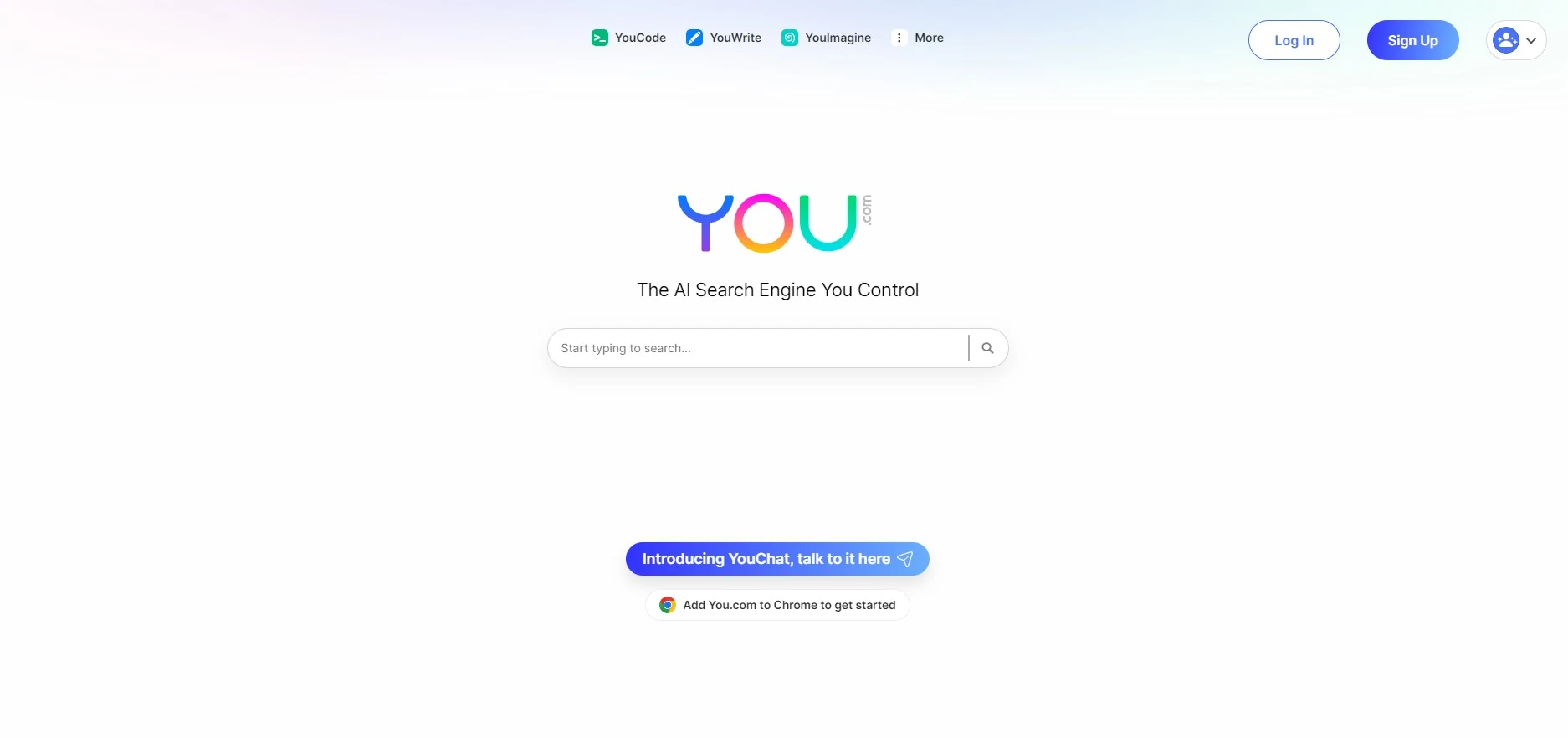
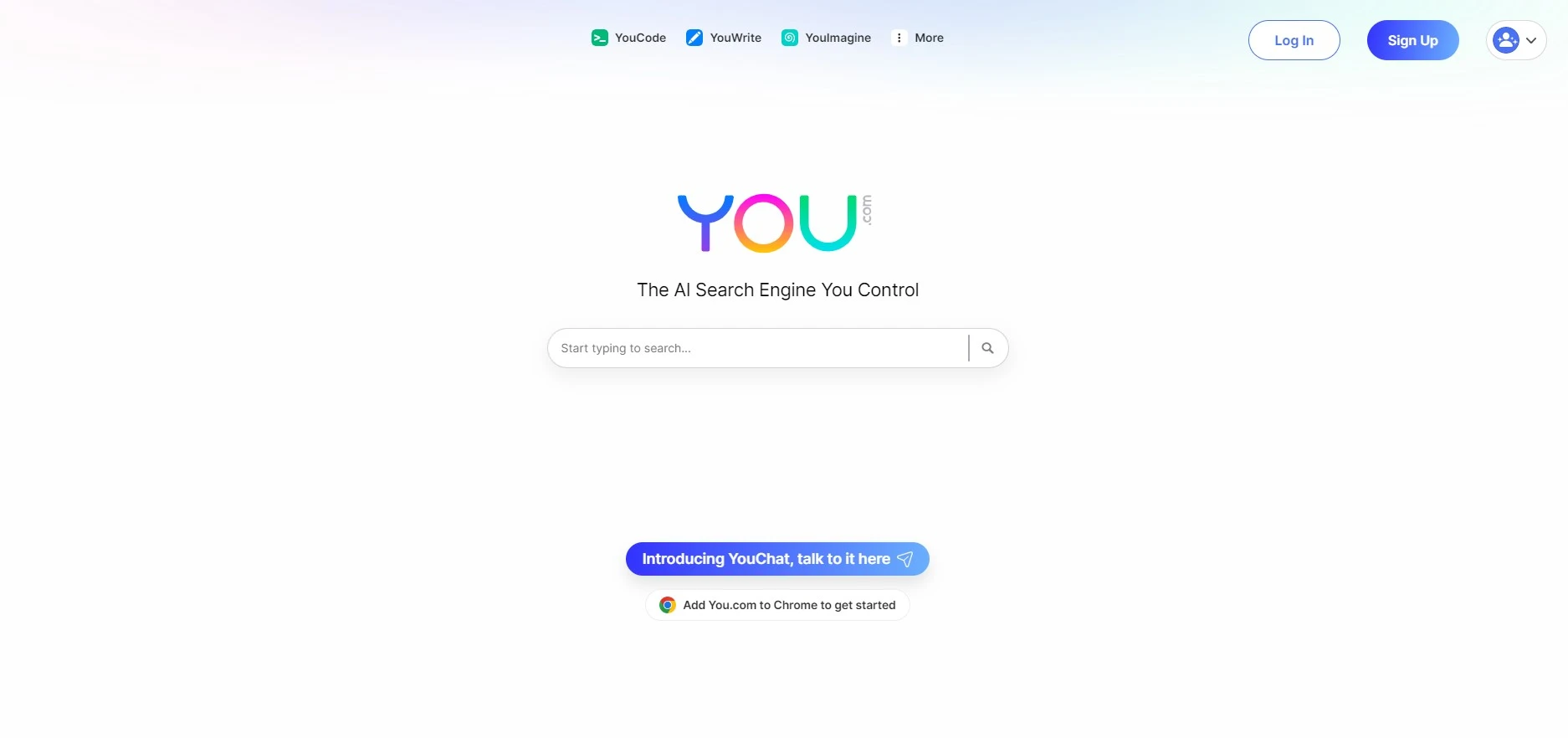
You.com: Google's Fierce Competitor Arriving with Rocket-Like Force Powered by Artificial Intelligence
What did we do before Google? Since its founding roughly 24 years ago, Google has dominated the search engine market and experienced unprecedented growth.
Conversely, the Google search engine has truly changed the world — it has become an essential part of our lives. Imagine asking a question one day and not finding the search engine on your device!
All roads lead to Google. Want to find new information? You have the Google search engine — which controls more than 92% of the search engine market share. Want to get somewhere? You have Google Maps. Want to watch videos for entertainment? You have YouTube, and much more. After all, Google is with you wherever you go on the internet.
Therefore:
There are some companies and some individuals who are thinking about changing this situation — namely, how Google dominates our lives in this way, especially its control over the search engine market,
because if the Google search engine ever broke down or stopped working for any reason, the way we interact with the internet would change entirely!
Among them was a man named Richard Socher — who was the Chief Scientist at Salesforce — who designed a new search engine called (You.com) based on artificial intelligence to compete with Google's dominant market.
Richard Socher believes that the greatest impact we can have on life right now is to build a trustworthy search engine that relies on artificial intelligence and natural language processing to help users make complex and diverse life decisions, such as the process of purchasing complex products.
Also:
Socher stated that all search engines have looked more or less similar over the past few years because their developers assumed that search results must be ranked in a text list,
ordered from the most popular sites to the least popular. Socher finds in this the core idea behind his new engine's differentiation.
How is You.com Different from Google?
While most search engines differentiate themselves from Google by focusing on privacy,
You.com takes a different approach by focusing on how search results are displayed — in boxes that separate information based on the nature of the results,
such as: images and videos from YouTube, tweets from Twitter, posts on LinkedIn, Reddit, Quora, and other apps.
In addition to these sources, You.com relies on Microsoft's Bing search engine for many of its results.
The Core Idea Behind You.com
is that web searching is better with apps that can appear as tools within search result pages.
If you trust a source such as: Stack Overflow for software, BBC News for news, or Yelp for information about places, you can add them to your search experience.
Every time you type a search term in You.com,
it searches both web and app results to display the most relevant ones so you can find more results quickly. These results are ranked as follows:
Like other search engines, website links are displayed in a vertical order.
Results from apps: customize apps to display their results as horizontally arranged boxes.
Therefore,
You.com's interface gives users more customization by allowing them to interact with content by scrolling up and to the right, and by moving resources up and down according to their preferences.
The engine currently has more than 250 apps and has opened its platform to third-party developers, allowing them to build their own search apps.
Richard Socher, founder and CEO of You.com, said: “Our goal is to create a competitor to Google that is not only more private, but also more open to app developers and more customizable for users”.
How does an app appear in You.com search results?
Integrating apps into a search engine is harder than it seems, because for any given search, the You.com algorithm must determine whether a particular app is relevant enough to appear.
Therefore, You.com also introduced user controls where users can like or dislike apps to help the algorithm rank future searches.
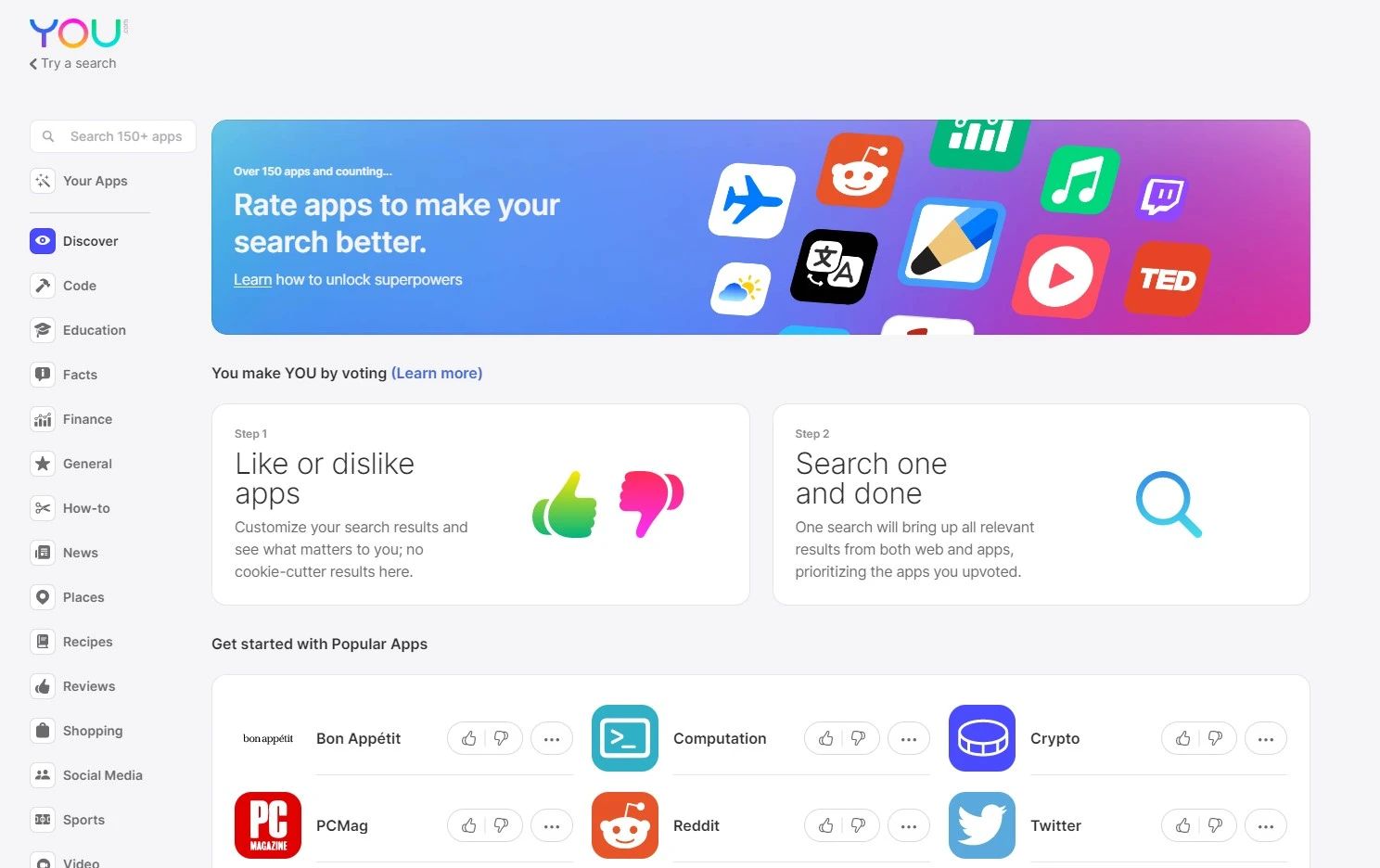
You.com includes an app store, which appears at the bottom of every results page, through which you can select which apps should appear in your search results. For example: if you are searching for the game (Call of Duty), you might want to do a quick search within the YouTube or Twitch app. If you often search for news, you can add specific sources such as: Associated Press or Reuters.
Also:
For users, they can select which apps appear in search results by liking their favorite apps in the app store, allowing them to see information from the sources they trust and prefer first. The app.
When a user likes or dislikes an app, it changes the algorithm's ranking of results according to their preferences. This means that every time they search, the results are personalized to their preferences.
The search engine and artificial intelligence technology:
The You.com search engine began offering an interactive chatbot called (YouChat) on its website at the end of December of last year, which is based on artificial intelligence — similar to ChatGPT — and can answer questions and perform actions in user conversations in any case.
Also:
The site also notes that the YouChat bot is in a beta phase and may have limited answer accuracy, and experience has shown that it will sometimes give incorrect answers.
There is no doubt that the sudden popularity of ChatGPT bots has pushed many companies to incorporate the same technology into their products,
even when it provides wrong answers.
So ChatGPT and YouChat are currently just examples of the future of artificial intelligence in search engines.
Socher said in a statement “that he believes integrating interactive chat into the You.com engine will help it distinguish itself from Google because people are looking for something new”.
It is worth noting that Google has a bot-like technology similar to (ChatGPT) called (LaMDA) that has not been announced
in its products yet due to the possibility of it providing wrong or biased answers, or beginning to repeat hate speech.
Similarly, other chatbots from Microsoft and Facebook and others will suffer from these issues.
As such,
expect Google to soon use its (LaMDA) technology in new products, in addition to the extensive use of artificial intelligence in search and the continuous development of search algorithms to combat misleading or unwanted content.
Does You.com Show Ads?
The first beta version of You.com was launched in late 2021, and the site has since gained more than one million active users, although the company has not mentioned the actual number of visits those users made each day.
Socher acknowledges that the site is still small, so it has not attracted major companies yet, but so far more than 500 developers have applied to build their own apps, and the site has selected 15 of them to join initially, including: the ListenNotes podcast search engine and the shopping site Price.com.
For these small companies,
You.com offers many incentives, not least of which is increased visibility of your product or service in search results.
The site also provides revenue sharing when users purchase products through app search results, and plans to offer search subscriptions.
Heck; You.com plans to display ads in search results, similar to ads in other privacy-focused search engines like DuckDuckGo and Brave.
These ads will be based on what the user is searching for (keywords),
not their search history, because You.com retains user search history by default,
but offers a feature called (Privacy Mode) that allows users to toggle between keeping their search history on or turning it off, similar to the incognito mode in a web browser.
Is You.com a Serious Competitor to Google Search?
Of course not at the moment,
You.com is still a new concept in the search engine market,
and it also has some technical issues, as its loading time is considerably slower than the Google search engine,
and the search algorithm must continuously improve through app likes and dislikes, which may make users feel fatigued.
But it cannot be denied that You.com is a search engine and that the core concept
of aggregating results from apps and services that users care about deserves to succeed,
so if You.com succeeds in attracting more developers and integrating them better with upcoming apps
in search results, we may finally have an alternative to the Google search engine that can be used for reasons other than just privacy.
And with that, dear friend, we have successfully completed our mission 
With greetings from the #Ezznology team
Find what interests you on our store