Galgotias University's appearance at the India AI Impact Summit in New Delhi turned into a public embarrassment after the university was asked to leave the exhibition area. The trigger was a video clip that spread quickly across social media. It raises a bigger question: how do we tell real innovation from marketing in the AI race?
What Happened at the University's Booth?
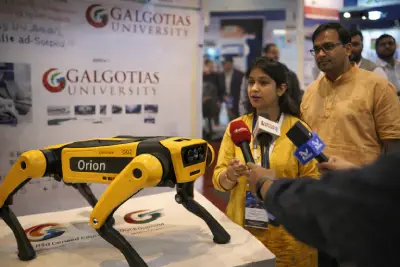
The university displayed a four-legged robot it called "Orion" and presented it as a product of its own Centre of Excellence. Internet users soon pointed out that the device was actually a Unitree Go2, made by the Chinese company Unitree and sold in the Indian market for roughly 200,000 to 300,000 rupees.
The exhibition was held at Bharat Mandapam in the Indian capital, at an event the government wanted to use as a showcase for the country's AI ambitions.
The Video That Started It
The circulating clip showed a university representative demonstrating the robot to the media and saying it had been developed by the centre. Another faculty member repeated the same claim. According to Indian press reports, the most quoted remark was made in an interview with the state broadcaster DD News.
Once the video spread, users began sharing the robot's original specifications and photos from the manufacturer's website. The university was accused of passing off a foreign product as its own, at a time when India is pushing hard to support local innovation and reduce its reliance on imported technology.
A Retreat and Conflicting Explanations
As criticism grew, the university posted a statement on X saying the robot had been bought from Unitree and was displayed as a teaching tool for students, and that it "never claimed to have manufactured it". That explanation clashed with the videos, in which its representatives clearly said the robot was their own work.
In a later statement, the university called the criticism a "propaganda campaign" against it. Its post then received a Community Note stating that the robot had indeed been shown under a new name and presented as a local innovation. Indian media later reported that the university apologised for the "confusion" and said its representative at the booth had been "ill-informed".
Misunderstanding or Misleading?
Professor Neha, from the School of Management and Communication, who appeared in the video saying the robot was developed in-house, later described the episode as a "misunderstanding". She said she is not an AI specialist, may not have expressed herself accurately, and that the robot was there for display only.
Was the University Really Removed?
While reports said the university had been pushed out of the exhibition area, another professor, Aishwarya Shrivastava, said at the time that they had received no official expulsion notice. Media outlets, however, quoted India's IT Secretary S. Krishnan as saying the government does not want exhibitors to display products that are not their own, and the head of the IndiaAI Mission criticised the university for creating a controversy while "the whole world" was watching.
What Is the Unitree Go2?
Unitree is a Chinese company known for quadruped robots priced well below many Western rivals, which is why its machines are common in universities and research labs. The Go2 is an off-the-shelf commercial robot that developers can program and build applications on, which makes it a sensible teaching platform.
That is the heart of the issue. Buying a ready-made robot to train students is normal and useful. The mistake is renaming an imported product and calling it a home-grown invention.
Why It Matters for Arab Readers
Arab countries are investing heavily in AI, and tech exhibitions, conferences and university competitions are increasingly common across the region. The lessons are simple:
- Transparency protects reputation: a line such as "a commercial platform running our own software" would have prevented the whole crisis.
- Audiences check fast: one photo compared with a manufacturer's website can expose a claim within hours.
- Brief your spokespeople: whoever stands in front of the cameras must know exactly what the institution actually built.
To keep up with everything new, follow Arabic websites and specialised blogs, along with Egypt stores, Kuwait stores, vitamin stores and international sites, and use Mashhor for social media services.
FAQ
Why was Galgotias University asked to leave the India AI summit?
It was asked to vacate its exhibition stall after a video showed its representatives presenting a Chinese-made Unitree Go2 robot, renamed "Orion", as the university's own development.
Did the university admit the robot was Chinese?
Yes. It said it bought the robot from Unitree for teaching purposes, then apologised for the confusion while insisting it never meant to claim it had built it.
Is it wrong for universities to use ready-made robots?
No. It is a common and useful way to teach programming and robotics. The problem only starts when a bought product is presented as an original invention.
Despite the conflicting accounts, the incident is still debated in India's academic and tech circles, given how sensitive national innovation has become as the country works to establish itself as a rising AI power. For any institution, the takeaway is clear: being honest about what you built costs far less than correcting a claim that has already been exposed.