What Is a Protocol? | Network Protocol Definition
In networking, a protocol is a standardized set of rules for formatting and processing data. Protocols enable computers to communicate with one another.
What Is a Network Protocol?
In networking, a protocol is a set of rules for formatting and processing data. Network protocols are like a common language for computers. The computers within a network may use vastly different software and hardware; however, the use of protocols enables them to communicate with each other regardless.
Standardized protocols are like a common language that computers can use, similar to the way two people from different parts of the world may not understand each other's native languages, but they can communicate using a shared third language. If one computer uses the Internet Protocol (IP) and so does another, they will be able to communicate — just as the United Nations relies on its six official languages to communicate among representatives from around the world. But if one computer uses IP and the other does not know this protocol, they will be unable to connect.
On the Internet, there are different protocols for different types of processes. Protocols are often discussed in terms of which OSI model layer they belong to.
What Are the OSI Model Layers?
The Open Systems Interconnection (OSI) model is an abstract representation of how the Internet works. It has 7 layers, with each layer representing a different category of networking functions.
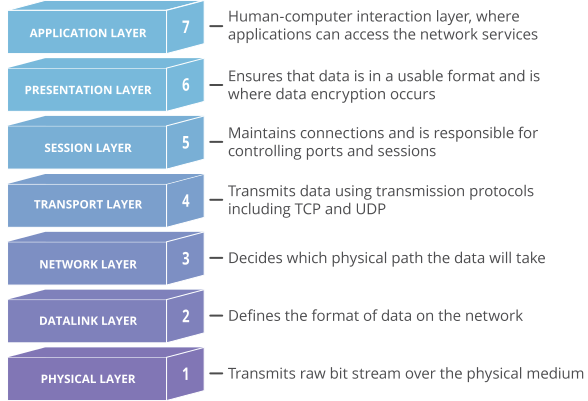
Protocols make these networking functions possible. For example, the Internet Protocol (IP) is responsible for routing data by indicating the source of data packets* and what their destination is. IP makes network-to-network communication possible. Therefore, the Internet Protocol is considered a network layer (layer 3) protocol.
As another example, the Transmission Control Protocol (TCP) ensures that the transfer of data packets across networks goes smoothly. Therefore, TCP is considered a transport layer (layer 4) protocol.
* A packet is a small segment of data; all data sent over a network is divided into packets.
What Protocols Run at the Network Layer?
As noted above, IP is a network layer protocol responsible for routing. But it is not the only network layer protocol.
IPsec: Internet Protocol Security (IPsec) sets up encrypted, authenticated IP connections over a virtual private network (VPN). Technically, IPsec is not a protocol but a suite of protocols that includes the Encapsulating Security Protocol (ESP), Authentication Header (AH), and Security Associations (SA).
ICMP: The Internet Control Message Protocol (ICMP) reports errors and provides status updates. For example, if a router is unable to deliver a packet, it will send an ICMP message back to the source of the packet.
IGMP: The Internet Group Management Protocol (IGMP) sets up one-to-many network connections. IGMP helps set up multicasting, meaning multiple computers can receive data packets directed to one IP address.
What Are Some Other Protocols Used on the Internet?
Some of the most important protocols to know are:
TCP: As mentioned above, TCP is a transport layer protocol that ensures reliable data delivery. TCP is meant to be used with IP, and the two protocols are often referenced together as TCP/IP.
HTTP: Hypertext Transfer Protocol (HTTP) is the foundation of the World Wide Web, the Internet that most users interact with. It is used for transferring data between devices. HTTP belongs to the application layer (layer 7), because it puts data into a format that applications (such as a browser) can use directly, without further interpretation. The lower layers of the OSI model are handled by a computer's operating system, not applications.
HTTPS: The problem with HTTP is that it is not encrypted — any attacker who intercepts an HTTP message can read it. HTTPS (HTTP Secure) fixes this by encrypting HTTP messages.
TLS/SSL: Transport Layer Security (TLS) is the protocol that HTTPS uses for encryption. TLS used to be called Secure Sockets Layer (SSL).
UDP: The User Datagram Protocol (UDP) is a faster but less reliable alternative to TCP at the transport layer. It is often used in services such as video streaming and gaming, where fast data delivery is of utmost importance.
What Protocols Do Routers Use?
Network routers use certain protocols to discover the most efficient network paths to other routers. These protocols are not used to transfer user data. Important network routing protocols include the following:
Also:
BGP: Border Gateway Protocol (BGP) is an application layer protocol used by networks to broadcast the IP addresses they control. This information allows routers to determine which network data packets should pass through on the way to their destinations.
EIGRP: Enhanced Interior Gateway Routing Protocol (EIGRP) determines distances between routers. EIGRP automatically updates each router's record of the best routes (called a routing table) and broadcasts these updates to other routers within the network.
OSPF: Open Shortest Path First (OSPF) calculates the most efficient network routes based on a variety of factors, including distance and bandwidth.
RIP: Routing Information Protocol (RIP) is an older routing protocol that determines distances between routers. RIP is an application layer protocol.
How Are Protocols Used in Cyberattacks?
Just as with any aspect of computing, attackers can exploit the way network protocols work to overwhelm or confuse systems. Several of these protocols are used in distributed denial-of-service (DDoS) attacks. For example, in a SYN flood attack, an attacker takes advantage of the way TCP works. They repeatedly send SYN packets to initiate a TCP handshake with the server, until the server is unable to provide service to legitimate users because its resources are tied up by all the fake TCP connections.
And with that, my friend, we have successfully completed our mission 
With greetings from the #Ezznology team
Find what you need at #our store
To subscribe to our newsletter on Google News, click here👇👇

Or scan the code